
Este blog ha terminado, pero permanecerá en línea. Hemos comenzado un nuevo blog, Carpeta Monetaria, en donde Genevieve Signoret está en la conversación global sobre política monetaria.
Gracias por su lectura y sus comentarios. ¡Esperamos verlos en Carpeta Monetaria!
22 June 2011


17 November 2010
What Roubini said / Lo que dijo Roubini
(Para español, desplácese hacia abajo.)
Nouriel Roubini made various claims and predictions today in an interview on CNBC:
Hoy en entrevista en CNBC, Nouriel Roubini predijo y afirmó:
Nouriel Roubini made various claims and predictions today in an interview on CNBC:
- QE2 will be followed by several more rounds, up to QE4 or QE5. (This prediction matches the TransEconomics view that, if necessary, the Fed will end up more than doubling the size of its balance sheet to to $5 trillion.)
- David Cameron and Mervyn King in the UK have an implicit agreement whereby the Bank of England will offset Treasury tightening with monetary loosening. The monetary loosening will take the form of QE2 a l'anglaise and will start as soon as fiscal pain (rock throwing) becomes unbearably intense.
- Given falling output in the European Union periphery and deflationary fiscal policy in Europe, the European Central Bank's current resistance to more quantitative easing is "not productive".
- We will probably see private orderly restructuring of sovereign debt in Greece first, then Portugal, and finally Ireland.
- Restructuring can take the form of exchange deals: sovereigns exchange outstanding bonds for some other assets. This is worked out with bondholders: no supranational entity (EU or IMF) need be involved.
- QE2 in the USA coupled with insufficiently fast appreciation of the Chinese yuan can lead to new or enlarged existing asset bubbles in China, even if China tightens credit and money.
Hoy en entrevista en CNBC, Nouriel Roubini predijo y afirmó:
- Después de esta ronda de estímulo cuantitativo (QE2) nos esperan más rondas, hasta QE4 or QE5. (Este punto es consistente con nuestra opinión en TransEconomics de que, si es neceario, la Fed más que duplicará el tamaño de su balance, hasta $5 billones.)
- David Cameron y Mervyn King en el Reino Unido tienen un acuerdo implícito según el cual Banco de Inglaterra contrarrrestará la política restrictiva del Tesoro con estímulo cuantitativo. El estímulo tomará la forma de un QE2 a la inglesa y comenzará tan pronto el dolor fiscal se torne insportable (los disturbios aumenten).
- Dada la contracción económica en la periferia de la Zona del Euro y la restricción fiscal en Europa, la resistencia del BCE a aplicar más estímulo cuantitativo (que el BCE llama "relajamiento crediticio") "no es productiva".
- Probablemente veremos una ordenada reestructuración privada de deuda en Grecia, primero, luego Portugal e Irlanda.
- Estos soberanos pueden canjear bonos por algún otro activo. El trato puede hacerse con inversionistas privados, sin que intervenga ninguna institución subpranacional del tipo FMI o Unión Europea.
- Aunque China restrinja el crédito y el dinero, QE2 en EEUU y demasiado lenta depreciación del yuan pueden provocar que en China la inflación se acelere y las burbujas financieras se multipliquen y se expandan.
08 November 2010
Fed lending standards, Fed Bullard speech, OECD leading indicator
Here are links to this morning's key global releases:
Fed: The October 2010 Senior Loan Officer Opinion Survey on Bank Lending Practices. Key quote (bold face is mine):
When nominal rates are at zero, as they are today, the Fed needs to persuade the public that in the future inflation will accelerate and stay rather high. (Which is not to say that hyperinflation will set in. Hyperinflation is of cours undesirable, but more importantly, it's in no way an inevitable consequence of QE, in my view. I don't even see it as a threat.)
OECD Composite Leading Indicators. Key content:
Fed: The October 2010 Senior Loan Officer Opinion Survey on Bank Lending Practices. Key quote (bold face is mine):
The October survey indicated that, on net, banks eased standards and terms over the previous three months on some categories of loans to households and businesses.2 Both large and other domestic banks reported having eased some standards and terms; large banks were primarily responsible for the easing reported in July.3 However, substantial fractions of banks reported in response to a set of special questions that standards for many categories of loans would not return to their longer-run averages for the foreseeable future.SF Fed Bullard's speech. Highlight:
Bullard said the FOMC must defend its implicit inflation target from the low side as it would from the high side. Since U.S. short-term interest rates are already approximately zero, further disinflation would mean rising real interest rates in the face of a slowing pace of recovery.Remember that we economists believe that people make saving and investment decisions based on the real interest rate: the nominal rate minus the rate of inflation expected over the investment decision time horizon.
When nominal rates are at zero, as they are today, the Fed needs to persuade the public that in the future inflation will accelerate and stay rather high. (Which is not to say that hyperinflation will set in. Hyperinflation is of cours undesirable, but more importantly, it's in no way an inevitable consequence of QE, in my view. I don't even see it as a threat.)
OECD Composite Leading Indicators. Key content:
OECD composite leading indicators (CLIs) for September 2010 point to diverging patterns of economic growth across major economies.
The CLIs show signs of continuing expansion in Germany, Japan, the United States and Russia, while pointing to a moderate downturn in Canada, France, India, Italy and the United Kingdom.
The CLIs for Brazil and China continue to point strongly downwards, edging below the long term trend and implying that the level of industrial production will fall below its longer-term trend in these two economies.
There's no time to get this into Spanish, now, as I'm heading out the door on a business trip.
Follow me on Twitter: @gisgnoret
Zoellick, explain yourself. Zoellick, explíquese.
Zoellick wrote this:
Martin Wolf argued (persuasively, in my view) against a gold standard last week.
Gold prices move up and down with global levels of fear. We're to link exchange rates to fear? Even when we might fear opposite things (deflation, inflation)?
*****
Zoellick escribió esto (es mi traducción):
Martin Wolf arguyó en contra de un estándar de oro (en mi opinión de manera persuasiva) la semana pasada.
El precio del oro sube y baja con el nivel global de miedo. ¿Debemos vincular la política cambiaria al miedo? ¿Aunque temamos fenómenos contradictorios (deflación, inflación)?
The [G20] system should also consider employing gold as an international reference point of market expectations about inflation, deflation and future currency values.Krugman and De Long have already responded (impolitely).
Martin Wolf argued (persuasively, in my view) against a gold standard last week.
Gold prices move up and down with global levels of fear. We're to link exchange rates to fear? Even when we might fear opposite things (deflation, inflation)?
*****
Zoellick escribió esto (es mi traducción):
El sistema [G20] debería también contemplar el uso del oro como referencia internacional de las expectativas en torno a la inflación, la deflación y cuánto valdrá en el futuro cada divisa.Krugman y De Long ya contestaron (de manera descortés).
Martin Wolf arguyó en contra de un estándar de oro (en mi opinión de manera persuasiva) la semana pasada.
El precio del oro sube y baja con el nivel global de miedo. ¿Debemos vincular la política cambiaria al miedo? ¿Aunque temamos fenómenos contradictorios (deflación, inflación)?
06 November 2010
Hoy sí
Bernanke explicó QE2 para el público en el Washington Post el jueves pasado. El párrafo clave es el siguiente:
Pero con una excepción: antes no se justificaban decisiones de política monetaria por su efecto en los precios accionarios.
Hoy sí.
This approach eased financial conditions in the past and, so far, looks to be effective again. Stock prices rose and long-term interest rates fell when investors began to anticipate the most recent action. Easier financial conditions will promote economic growth. For example, lower mortgage rates will make housing more affordable and allow more homeowners to refinance. Lower corporate bond rates will encourage investment. And higher stock prices will boost consumer wealth and help increase confidence, which can also spur spending. Increased spending will lead to higher incomes and profits that, in a virtuous circle, will further support economic expansion.Justifca otra ronda de relajamiento cuantitativa (quantitative easing, or QE) con base en lo siguiente:
- Funcionó en el pasado (en la primera ronda).
- Con sólo anunciar la intención avanzó la bolsa de valores.
- Promoverá crecimiento económico: bajando las tasas de interés hipotecarias; bajando los rendimientos de los bonos corporativos (lo que promoverá inversión fija); elevando los precios accionarios, lo que, por enriquecer a los consumidores, puede impulsar más gasto.
Pero con una excepción: antes no se justificaban decisiones de política monetaria por su efecto en los precios accionarios.
Hoy sí.
Sígueme en Twitter: @gsignoret
I'm glad we use Eurostat for Spanish labor data
Edward Hughes warns us to be careful in interpreting Spanish labor data. It's a good lesson in the perils of trying to perceive changes on the margin from data not seasonally adjusted. Hughes is scathing in tone:
But the way they present the data isn’t interesting, in fact its downright misleading. In particular they chose not to seasonally adjust the data – which in a seasonally driven economy like the Spanish one with significant ups and downs in tourist activity doesn’t make much sense – and this omission is not only lazy, it is negligent. (Read the whole post.)It turns out that although Spain's statistical agency's (INE's) unadjusted unemployment series shows month-on-month improvement, the seasonally adjusted series shows worsening.
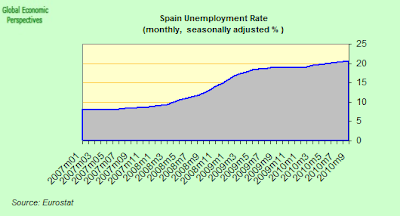
For our own global macro database we have always relied on Eurostat's time series for Spain. We did this for one-stop shopping and comparability with the rest of the Euro Area.
Now we have another justification.
How might QE2 boost commodities prices? ¿Cómo podría QE2 elevar los precios de las materias primas?
(Para la versión en español, desplácese hacia abajo.)
The Fed's second round of quantitative easing (QE2) can boost commodities prices through four channels. First, by depressing Treasury yields in the middle of the yield curve and (it is hoped) by inflating prices generally, it can exert downward pressure on the U.S. dollar against other currencies such as the euro.
Of course, this would boost global commodities prices in dollar terms only (it would have the opposite effect on prices in euro terms, for example).
This tranmission channel pertains to all segments of commodities. Equally, it pertains to all other traded goods and services priced in U.S. dollars. QE2 is aimed, after all, at inflating dollar prices.
Second, by generating confidence that the U.S. economy will avert deflation and thus stir up hopes that growth will take off, it can draw speculators into the futures markets for industrial commodities: energy commodities and base metals.
Third, by generating fear of hyperinflation even while boosting high hopes for industrial commodities (in an unusual confluence of events), it can provide support for precious metals. Of course, this support will be iffy and unstable, as with any price support that relies on mere raw feelings such as fear.
Fourth, by depressing Treasury yields (in the middle of the curve), it can draw investors desperate for yield into the asset class.
**************
La segunda ronda de relajamiento cuantitativo (QE2) de la Fed puede dar ímpetu a los precios de las materias primas por cuatro vías. Primero, al deprimir los rendmientos de los bonos del Tesoro en medio de la curva, puede deprimir el dólar frente a otras monedas como es el euro.
Claro, este fenómeno reforzaría los precios de las materias primas en términos únicamente del dólar (tendría el efecto contrario en las cotizaciones en euros, por ejemplo).
Esta via se aplicaría a todos los segmentos de las materias primas. Asímismo, se aplicaría a la cotización en dólares de cualquier otro bien o servicio transable. El propósito del QE2, recuérdese, es inflar los precios en dólares.
Segundo, si genera confianza en que la economía estadounidense puede evitar la deflación y así despertar esperanzas de que el crecimientos despegue, puede atraer inversión especulativa hacia los mercados de futuros de materias primas industriales: energéticos y metales base.
Tercero, al generar miedo de hiperinflación al mismo tiempo que despertar esperanzas para las materias primas industriales (en una coincidencia de eventos inusitada), puede dar soporte a los metales preciosos. Claro, dicho soporte será incierto e inestable, como suele ser el caso cuando un precio toma su soporte de puros sentimientos primitivos.
Cuarto, al deprimir los rendimientos del Tesoro (a la mitad de la curva), puede incitar a inversionistas en búsqueda desesperada de retornos a entrar en esta categoría de inversión.
The Fed's second round of quantitative easing (QE2) can boost commodities prices through four channels. First, by depressing Treasury yields in the middle of the yield curve and (it is hoped) by inflating prices generally, it can exert downward pressure on the U.S. dollar against other currencies such as the euro.
Of course, this would boost global commodities prices in dollar terms only (it would have the opposite effect on prices in euro terms, for example).
This tranmission channel pertains to all segments of commodities. Equally, it pertains to all other traded goods and services priced in U.S. dollars. QE2 is aimed, after all, at inflating dollar prices.
Second, by generating confidence that the U.S. economy will avert deflation and thus stir up hopes that growth will take off, it can draw speculators into the futures markets for industrial commodities: energy commodities and base metals.
Third, by generating fear of hyperinflation even while boosting high hopes for industrial commodities (in an unusual confluence of events), it can provide support for precious metals. Of course, this support will be iffy and unstable, as with any price support that relies on mere raw feelings such as fear.
Fourth, by depressing Treasury yields (in the middle of the curve), it can draw investors desperate for yield into the asset class.
Follow me on Twitter: @gsignoret
**************
La segunda ronda de relajamiento cuantitativo (QE2) de la Fed puede dar ímpetu a los precios de las materias primas por cuatro vías. Primero, al deprimir los rendmientos de los bonos del Tesoro en medio de la curva, puede deprimir el dólar frente a otras monedas como es el euro.
Claro, este fenómeno reforzaría los precios de las materias primas en términos únicamente del dólar (tendría el efecto contrario en las cotizaciones en euros, por ejemplo).
Esta via se aplicaría a todos los segmentos de las materias primas. Asímismo, se aplicaría a la cotización en dólares de cualquier otro bien o servicio transable. El propósito del QE2, recuérdese, es inflar los precios en dólares.
Segundo, si genera confianza en que la economía estadounidense puede evitar la deflación y así despertar esperanzas de que el crecimientos despegue, puede atraer inversión especulativa hacia los mercados de futuros de materias primas industriales: energéticos y metales base.
Tercero, al generar miedo de hiperinflación al mismo tiempo que despertar esperanzas para las materias primas industriales (en una coincidencia de eventos inusitada), puede dar soporte a los metales preciosos. Claro, dicho soporte será incierto e inestable, como suele ser el caso cuando un precio toma su soporte de puros sentimientos primitivos.
Cuarto, al deprimir los rendimientos del Tesoro (a la mitad de la curva), puede incitar a inversionistas en búsqueda desesperada de retornos a entrar en esta categoría de inversión.
Sígame en Twitter: @gsignoret
27 October 2010
More Web jewels found today
Tim Duy's Fed Watch, Too Little:
Federal Reserve policymakers must be pleased with themselves. Market participants have fallen in line like lemmings off a cliff pursuing the obvious trades as the excitement over quantitative easing builds. Equities, bonds, commodities are all up. Dollar is down. Perhaps more importantly, measured inflation expectations have trended higher. Psychology is a powerful thing. Like leverage. ... (keep reading).Prajakta Bhide et al (Nouriel Roubini's Economonitor), What's ahead for the Fed?:
An anemic and subpar U.S. recovery amid balance-sheet repair, weak demand, slack in the economy and disinflationary pressures has always been our baseline scenario. By the summer of 2010, the disinflationary bias in expectations had become more evident, and the economy—lacking a self-sustained recovery—had started heading toward a dangerous stall speed. We vocally expressed our concerns around deflation/stagnation/double-dip scenarios and called for more policy action, while recognizing that the effects on the real economy would be limited. (Keep reading.)Jon Hilsenrath and Jonathan Cheng ($WSJ), Fed Gears Up for Stimulus:
The Federal Reserve is close to embarking on another round of monetary stimulus next week, against the backdrop of a weak economy and low inflation—and despite doubts about the wisdom and efficacy of the policy among economists and some of the Fed's own decision makers. (Keep reading.)Marshall Eckblad ($WSJ), Banks Turn Their Reserves to Profit:
Call it steroids for bank profits.
The biggest U.S. banks virtually doubled their collective earnings in the third quarter just by injecting $8.1 billion into net income from funds they had set aside to cover loan losses.
There are 18 commercial banks in the U.S. with at least $50 billion in assets, and together they earned an adjusted $16.8 billion in the third quarter. Of those profits, nearly half, or 48%, were from drawing down what bankers call loan-loss reserves, according to an analysis by Dow Jones Newswires. A year ago, the same 18 banks earned $6.2 billion in quarterly profits; at that time, they added more than $7.8 billion to the same reserves, a move that reduced their profits. The analysis omits a $10.4 billion noncash charge to earnings that Bank of America Corp. disclosed during the third quarter. (Keep reading.)
¿Qué significa rendimientos de TIPS negativos para materias primas y crecimiento?
James Hamilton (Econbrowser) interpreta el hecho de que los bonos del Tesoro protegidos contra la inflación (TIPS) de nueva emisión estén pagando rendimientos negativos.
A quienes llaman "insólito" el evento de rendimentos negativos en TIPS, Hamilton contesta que rendimientos negativos en el mercado de bonos del Tesoro es la regla, no la excepción. Si no se ha presentado antes para el caso de TIPS es probablemente porque los TIPS son instrumentos relativamente nuevos:
Krugman aclara que esto se dará sólo si los precios de las materias primas suben en términos reales:
El riesgo de este escenario es particularmente alto en economías emergentes cuyos bancos centrales han adoptado el régimen de política monetaria por objetivos de inflación.
A quienes llaman "insólito" el evento de rendimentos negativos en TIPS, Hamilton contesta que rendimientos negativos en el mercado de bonos del Tesoro es la regla, no la excepción. Si no se ha presentado antes para el caso de TIPS es probablemente porque los TIPS son instrumentos relativamente nuevos:
Although this appears to be the first time that newly issued TIPS have locked in a negative real return, that's because TIPS have only been offered to U.S. investors since 1997. You can get a longer time series by comparing the yield on a 6-month T-bill at any date with what the CPI inflation rate actually turned out to be over the subsequent 6 months for which investors held that bill, a magnitude sometimes described as the "ex-post real interest rate." That series is plotted below. We've actually been in a period for several years in which short-term loans to the government were a losing proposition in real terms, and the longer-term real yields such as the 5-year TIPS are only now coming down to join them. The recent era of negative real yields was briefly (if spectacularly) interrupted in the fall of 2008, when a sharp deflation in the CPI made short-term loans to the government an excellent deal for the lender in ex-post real terms.Nos recuerda de su opinión (que coincide con la de Krugman) en torno a Relajamiento Cuantitativo 2 (QE2): ayudará pero probablemente poco. Hamilton menciona QE2 en una discusión sobre rendimientos reales de TIPS negativos porque precisamente lo que está comprimiendo los rendimientos de los TIPS (inflando sus precios) es el que los inversionistas anticipen que el iminente QE2 cause tasas de inflación más altas a futuro. Me imagino que por eso Hamilton prevé alzas en los precios de las materias primas:
Negative ex-post real rates on short-term securities are thus nothing new. We saw them for much of this decade and for much of the 1970s. Although negative realized ex-post real rates do not establish that investors knew that they were in for a losing bargain in real terms, they persisted long enough in the 1970s that it's hard to believe that people were shocked by the continually repeated outcome. I think if TIPS had been offered at that time, we would have seen a negative real yield then, too.
Hamilton evita caer en el error de varios analistas señalado hoy por Krugman, de decir que, como QE2 puede conducir a precios de materias primas más altos y esto puede deprimir la demanda, QE2 podrá resultar contraproducente para el crecimiento.Even so, within those models, there's an incentive to buy and hold those goods that are storable. And in terms of the historical experience, episodes of negative real interest rates have usually been associated with rapidly rising commodity prices.
Krugman aclara que esto se dará sólo si los precios de las materias primas suben en términos reales:
En realidad, Krugman omite mencionar un escenario en el que los precios de materias primas no suben en términos reales mas sí en términos nominales frena el crecimiento. El escenario se da cuando las alzas en materias primas aceleran cambios en los índices de precios al consumidor tanto que el banco central se siente obligado a aplicar política monetaria restrictiva.Higher commodity prices will hurt the recovery only if they rise in real terms. And they’ll only rise in real terms if QE succeeds in increasing real demand. And this will happen only if, yes, QE2 is successful in helping economic recovery.
What this official is saying is a version of the classic freshman mistake: an increase in demand leads to higher prices, and higher prices make people buy less, so an increase in demand leads to lower sales.
El riesgo de este escenario es particularmente alto en economías emergentes cuyos bancos centrales han adoptado el régimen de política monetaria por objetivos de inflación.
24 October 2010
A nice week-ahead calendar for EM followers. Lindo calendario para seguir mercados emergentes.
I'm now following the EM blog called beyondbrics at FT.
On Sundays they post a neat week-ahead EM calendar that includes release dates for both macro indicators and and corporate earnings reports.
******
Ya estoy seguiendo un blog enfocado en mercados emergentes de FT llamado beyondbrics.
En domingo se publica ahí un lindo calendario semanal que incluye fechas no sólo para indicadores macro sino también para reportes de ganancias corporativas.
G20 communiqué and Geithner's letter. Comunicado G20 y carta de Geithner.
Por alguna razón, no encuentro la carta de Geithner a los ministros de finanzas G20 en el sitio del Tesoro de EEUU así que proporciono vínculo a la carta proporcionada por WSJ ($). También el comunicado de los ministros G20 resultado del cumbre que se sostuvo este fin de semana.
Mañana daré mi reacción a ambos en relación a su probable impacto en México y en los mercados.
Somehow I can't find Geithner's letter to G20 ministers on the Treasury Web site, so here's the WSJ link ($) to it. And while I'm at it, here's a link to the full G20 communiqué that came out of this weekend's summit.
Tomorrow I'll react to both: What do they mean for Mexico? For markets?
Follow Genevieve Signoret on Twitter: @gsignoret.
19 October 2010
Is Mexico a 100 Year Bet?
The FT' congratulates Mexico on selling $ 1 bn of 100 year notes at 6.1 %, but suggests in the Lex column that this may be "a triumph of hope over experience". Interesting question. What do readers of this blog think?
12 October 2010

09 October 2010
¿Desendeudamiento: cuánto tiempo más? Deleveraging: how much longer?
Gillian Tett de Financial Times se preguntó antier cuánto falta para que termine la fase de desendeudamiento:
What is not evident, however, is how much further that debt now needs to decline to produce any sense of normality. We do not know, in other words, how far along we are into this “deleveraging” process, nor what this might mean for growth or asset prices.
Termina en una nota pesimista:The current data on the issue looks mixed. In some respects – and in some sectors – there might seem to be reason for cheer. The latest capital markets monitor from the Institute of International Finance, published this week, reports a “sharp decline in the liabilities of the US shadow banking system this year”, amid “ongoing deleveraging – in particular by US households”.
Total liabilities of the shadow banks have dropped from almost $22,000bn two years ago, to nearer $17,000bn, or where it was five years ago. “Debt levels for US households, businesses and particularly financial institutions continue to decline” the IIF notes, as a proportion of gross domestic product, towards levels seen earlier in the last decade.
A separate recent report from Citi’s European credit team reinforces that point. This data also suggests that a sharp deleveraging has already occurred for banks. And in the non-banking corporate world, net debt to ebitda for S&P non financials is now running at around 140 per cent, down from 210 per cent at the peak in late 2008. For the EuroStoxx non-financials, the ratio has moved from around 230 per cent to 170 per cent.
If the pattern seen in earlier economic cycles were to play out, investors should welcome this news. With debt levels suitably reduced, banks and companies should now feel confident enough to start borrowing again – and thus raising investment, spending and so on. But that does not appear to be occurring: after cutting debt, companies are still (for the most part) sitting on vast piles of cash; so, it seems are households. Meanwhile banks are resolutely refusing to make large volumes of new loans.
Why? One reason may be that the household sector is still running a big debt burden by historical standards, and is beset by unemployment. Another is that regulatory uncertainty is sapping corporate nerves. However, the Citi team thinks the biggest issue is that rising public sector debt is undermining confidence too, or creating a climate of “fear”, as Alan Greenspan wrote in the FT yesterday. Most notably, even as the private sector has delivered, public debt has exploded.
Thus the total scale of leverage in the system – namely the sum of both non-financial public and private debt – has not fallen markedly in the last two years (in America, for example, it is now running at around 220 per cent, compared to 170 per cent at the start of the decade.). Hence, Citi argues, investors cannot expect a “normal cycle”; companies and consumers alike are too shell-shocked by the recent past – and so uncertain about how governments will deal with all that public debt in the future. The most likely path for the next few years therefore is one of sluggish growth at best.
13 August 2010
Financial Market Team update (English, 13 Aug 2010)
Stocks
Since last Friday, stocks around the globe have fallen by about 4%. The next figures represent changes since last Friday. The DJIA fell 3.3%; the S&P, 3.8%. In Europe, UK's FTSE 100 fell 1.1% while the German DAX fell 2.4%. In Asia Japan's Nikkei 225 fell 4% while Hong Kong's Hang Seng fell 2.8%. In Latin America Mexico's IPC fell 2.5% and Brazil's Bovespa fell 2.7%.
Currencies
The yen and the euro weakened against the dollar.
Debt
The European Central Bank revealed today that the number of Spanish banks that borrowed from the ECB grew in July. Investors are being driven to German bonds. German 10-year Bund yields are at 2.39%, their all-time low. US 10-year Treasury yields are also lower, at 2.68%.
(Read more about financial markets in this FT article $)
Patrick Signoret and Georgina Lara
Financial Market Team update (data for 13 Aug 2010)
16:30 ET
DJIA: -0.16% to 10303
S&P 500: -0.4% to 1079
Mexico IPC: +0.18% to 32100
Brazil Bovespa: +0.45% to 66264
FTSE 100: +0.18% to 5275
DAX: -0.4% to 6110
Nikkei 225: +0.44% to 9253
Hang Seng: -0.16% to 21072
US$1.00= 0.78 euros
US$1.00= 12.73 Mexican pesos
US$1.00= 86.2 yen (+0.3%)
EUR$1.00= 1.28 USD (-0.6%)
WTI crude 1m: -0.46% to 75.39 USD/bbl.
Corn 1m: +1.3% to 427 USD/bu.
Wheat 1m (CBT): -1.28% to 734 USD/bu.
Gold 100 oz 1m: -0.01% to 1217 USD/t oz.
Aug 13 (Aug 12)
Ted spread: 21 (22)
T bill 3m: 0.15 (0.16)
USD Libor 3m: 0.37 (0.38)
12 August 2010
Power and Policy Team update (English) , 12 Aug 2010
Korea's monetary policy decision
The Bank of Korea maintained the Base Rate unchanged at 2.25%. A 25bp increase had been expected. (Read the BoK's statement.)
U.S. border security
U.S. Senators approved unanimously a new border security bill which gives the federal administration 600 million dollars which will allow, among other things, to send 1,500 more troops to the southern border. According to this article published by the La Times, lawmakers think that securing the border is the first step to a more comprehensive immigration reform.
Israel and Iran
According to this month’s Atlantic Monthly magazine there is a 50 percent probability that Israel will attack and destroy Iran’s nuclear program by next summer. However, according to The Christian Science Monitor, these allegations are only rhetorical games to pressure Obama to attack Iran.
Patrick Signoret and Isabel Gil
Financial Market Team update (data for 12 Aug 2010)
13:51 ET
DJIA: -0.69% to 10307
S&P 500: -0.69% to 1082
Mexico IPC: +0.06% to 32078
Brazil Bovespa: -0.04% to 65765
FTSE 100: +0.4% to 5266
DAX: -0.31% to 6135
Nikkei 225: -0.86% to 9213
Hang Seng: -0.89% to 21106
US$1.00= 0.78 euros
US$1.00= 12.74 Mexican pesos (-0.07%)
US$1.00= 85.86 yen (+0.63%)
EUR$1.00= 1.28 USD (-0.28%)
WTI crude 1m: -2.24% to 76.27 USD/bbl.
Corn 1m: +3.22% to 424 USD/bu.
Wheat 1m (CBT): +3.86% to 753 USD/bu.
Gold 100 oz 1m: +1.46% to 1217 USD/t oz.
EMBI+Mex: 137
Cetes 28d: 4.5%
Patrick Signoret and Georgina Lara
Financial Market Team update (English, 12 Aug 2010)
13:37 ET
Stocks
Yesterday, the S&P 500 and the DJIA reached their lowest level since July 23. Today, both have been trading steadily below yesterday's close. At the end of the day, the FTSE100 managed to pare earlier losses. Major American, European and Asian markets fell today, continuing yesterday's trend.
Currencies
After reaching a 15-year high, the yen is being closely monitored by Japan's central bank although no specific action has been mentioned.
Commodities
Oil continues to fall for the fifth straight day. Gasoline futures reached a five-week low. Gold continues to rise and has reached its highest for a month. Floods in Pakistan are making sugar prices climb since 200,000 acres of cane were destroyed.
Patrick Signoret and Georgina Lara
11 August 2010
Choices in Economic Policy (USA...)
The IMF's Chief Economist and head of fiscal affairs argue in today's FT that 'measures that improve the long-term fiscal outlook in those countries with high deficits and debt' should receive top priority, and they suggest that reforms of pensions and health are among the politically feasible options. The only economist who has not jumped in to the debate on Stimulus vs. Austerity must be Karl Marx, and he is indisposed. I would like to see a requirement that all writers of Op-Ed pieces on this subject be required to suggest just how their proposals could actually become reality in the current dysfunctional US political system? What sort of crisis that cannot be foreseen (a 'Black Swan Event' ?) will it take to bring about the needed political consensus? A grandes males, grandes remedios?
Subscribe to:
Posts (Atom)